Showing posts with label ElaNa. Show all posts

January 18, 2021

ELaNa 20 CubeSats Deployed

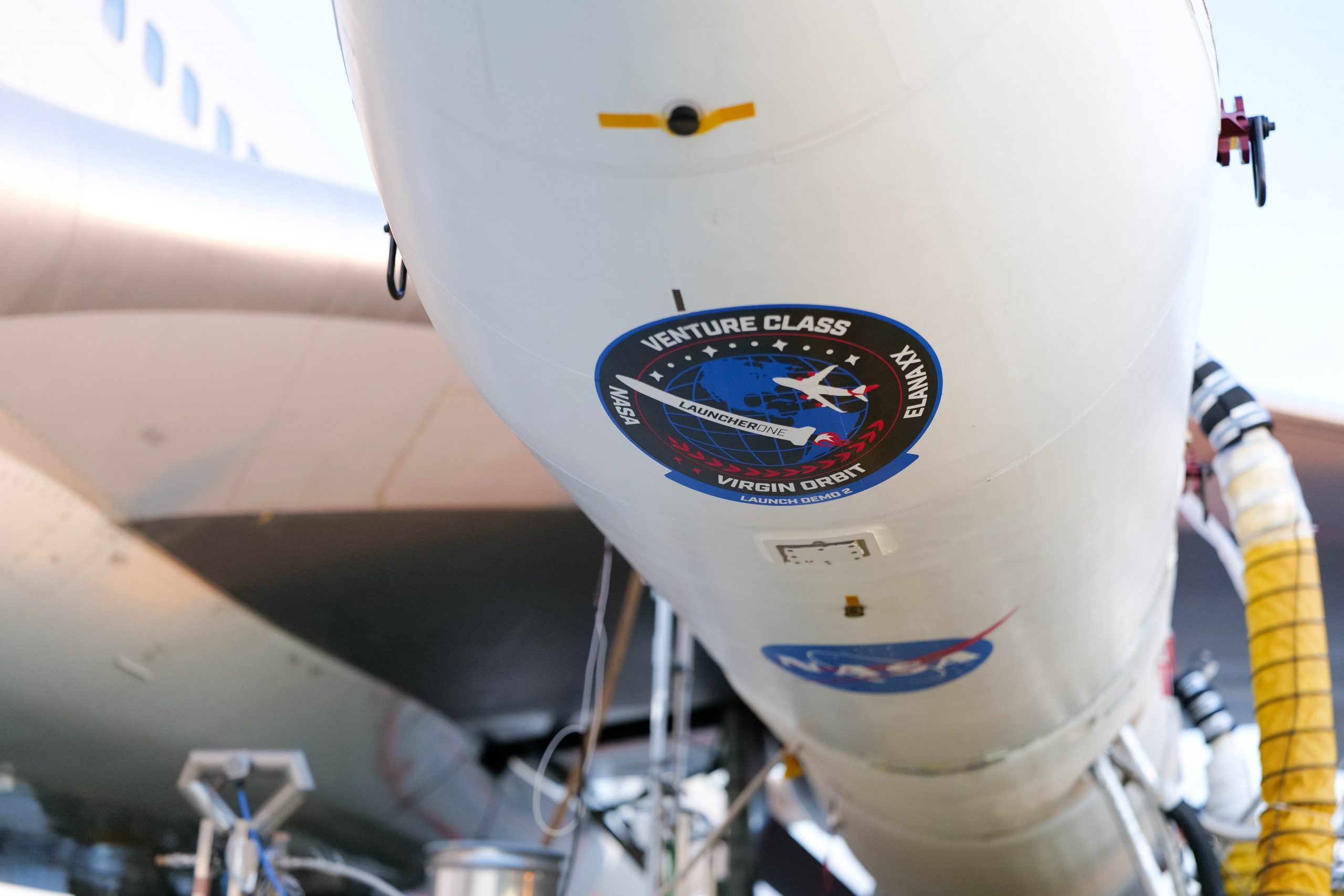
            Virgin Orbit’s LauncherOne system undergoes final preparations on a taxiway at Mojave Air and Space Port ahead of the company’s Launch Demo 2 mission. Taken in late December 2020. Photo: Virgin Orbit/Greg Robinson.

 Virgin Orbit’s LauncherOne system

Today at approximately 3:35 p.m. ET (12:35 p.m. PT), 10 CubeSats began deploying from Virgin Orbit’s LauncherOne Rocket into low-Earth Orbit as part of the Educational Launch of Nanosatellites (ELaNa) 20 mission. Virgin Orbit’s 747-00 carrier, Cosmic Girl, took off from the Mojave Air and Space Port in California at 1:38 p.m. ET (10:38 a.m. PT) today carrying the LauncherOne Rocket and the 10 small research satellites.

CubeSats are a cornerstone in the development of cutting-edge technologies like laser communications, satellite-to-satellite communications, and autonomous movement. The nine CubeSat missions in this launch were developed by the following universities and one NASA center:

  • CACTUS-1 – Capitol Technology University, Laurel, Md.
  • CAPE-3 – University of Louisiana at Lafayette
  • EXOCUBE – California Polytechnic State University, San Luis Obispo
  • MiTEE – University of Michigan, Ann Arbor, Mich.
  • PICS (two CubeSats) – Brigham Young University, Provo, Utah
  • PolarCube – University of Colorado at Boulder
  • Q-PACE – University of Central Florida, Orlando, Fla.
  • RadFXSat-2 – Vanderbilt University, Nashville, Tenn.
  • TechEdSat-7 – NASA Ames Research Center, Moffett Field, Calif.

CSLI is an initiative created by NASA to attract and retain students in the science, technology, engineering and mathematics disciplines. Missions are selected through the CubeSat Launch Initiative and managed by NASA’s Launch Services Program at the agency’s Kennedy Space Center in Florida. Visit our website to learn more and follow us on Twitter at NASA_LSP and Facebook at NASA LSP.

 read more Kennedy Space Center


December 6, 2013

ELaNa-5 cubesats

Twelve CubeSats are set to launch aboard an Atlas V rocket with the NROL-39 primary payload from Vandenberg AFB in California on December 5, 2013. The CubeSat payloads have been provided through NASA's Educational Launch of Nanosatellites (ELaNa) program and the NRO's Mission Integration Directorate (MID). Atlas V GEMSat Launch 2013

IPEX (Intelligent Payload Experiment)
Cal Poly
Mission  to demonstrate operation of autonomous instrument processing, downlink operations, and ground station operations, utilizing the SpaceCube Mini payload processing unit to validate a reduction in data product downlink.


Call sign: KJ6KSL
Frequency: 437.270 MHz
Modulation: AX.25 FSK (NRZI with G3RUH scrambling)
Data Rate: 9600 Buad
Beacon Info:
IPEX transmits three types of beacons:
-Health Beacon: Contains the latest snapshot of IPEX telemetry
-File Beacon: A portion of a much larger telemetry file, need to collect several file beacons
  to reconstruct the file (HEX data)
-Morse Code: 15 wpm, should spell “IPEX,” will be disabled after initial tracking to conserve power
http://polysat.calpoly.edu/

MCubed-2
The Michigan Exploration Laboratory
Mission to obtain a mid resolution image to date of Earth with at least 60% land mass and a maximum of 20% cloud coverage from a single cubesat platform.


Callsign:
Frequency: 437.485 MHzRate: 9600 Baud
Modulation: GMSK
Transmit Interval: 10 seconds
RF Power Output:
Antenna Polarization: Linear
Beacon Info:
437.485 MHz, 9600 baud, 10 sec period
Beacon Software decoder

FIREBIRD
Montana State University
Mission to resolve the spatial scale size and energy dependence of
electron microbursts in the Van Allen radiation belts.


Beacon Info:
Flight Unit 1: 437.405 MHz
Flight Unit 2: 437.230 MHz
GMSK AX.25 9600bps, 1W, 60 sec period

CUNYSAT-1
The City University of New York
Mission to  investigation of ionospheric disturbances using GPS signals.


Beacon Info:
437.505 MHz, 9k6 FSK, CW
(c) Cubesat.org & Gunter's Space

November 13, 2013

Tracker!!! be ready for November neck pain (1)

Launcher - Satellites name - Launching time - Frequencies - Mode .
Minotaur-1 rocket on 19 November 2013
Black Knight-1, CAPE-2, ChargerSat-1, COPPER, CSIP, DragonSat-1, Firefly, Ho'oponopono-2
KYSat-2, Lunar Orbiter/Lander CubeSat, NPS-SCAT, ORSES, ORS Tech-1,2, ORS-3, PhoneSat-v2
Prometheus-1,2,3,4, Rampart, SENSE-1,2, STARE-B, STPSat-3, SwampSat, TetherSat-1,2
TJ3Sat, Trailblazer-1, Vermont Lunar Cubesat .
NASA ELaNa (Educational Launch of Nanosatellites)

DNEPR rocket on 21 Nov.2013
UniSat-5 / AprizeSat-7,8, BPA-3, BRITE-PL1, CINEMA-2,3, CubeBug-2, Delfi-n3Xt
Dove-4, DubaiSat-2, Eagle-1,2, E-Star-2, First-MOVE, FUNcube-1, GOMX-1, HiNCube
Humsat-D, ICUBE-1, NEE-02 Krysaor, OPTOS, PUCP-SAT-1, Pocket-PUCP, Qubescout-S1
SkySat-1, STSat-3, Triton-1,2, UWE-3, VELOX-P2, WNISAT-1, Wren, ZACube-1
Multi nations NanoSats of Europe, USA, and South America and Asia.

ISS CubeSats on November 25, 2013.
PicoDragon,ArduSat-1,ArduSat-X,TechEdSat-3
Satellites Frequency List Update

Black Knight-1                   .            437.345             .
CAPE-2                           .            145.825/437.325     .
COPPER                           .            437.290             .         9600bps
DragonSat-1                      .            145.870             .
Ho'oponopono-2                   .            427.220             .         9600bps FSK/GMSK
KYSat-2                          .            437.405             .
NPS-SCAT                         .            437.525/2401.200-2447.600
PhoneSat-v2                      .            437.425/2401.200-2431.200
SwampSat                         .            437.385             .
TetherSat                        .            437.100/305         .         9600bps GFSK
TJ3Sat                           .            437.320             .
Trailblazer-1                    .            437.425             .
BRITE-PL1                        .            437.xxx, 2.2GHz
CubeBug-2                        .            437.445             .         1200bps AFSK, 9600bps FSK,GMSK
Delfi-n3Xt                    435.530-570     145.880-920         .         Transponder(U/V)
Delfi-n3Xt                       .            145.870/930         .         1200bps AFSK
Eagle-1                          .            437.465             .         9600bps GFSK
Eagle-2                          .            437.505             .         9600bps GFSK
E-Star-2                         .            437.485             .         1200bps AFSK
First-MOVE                    435.520         145.970             .         1200bps BPSK
FUNcube-1                     435.150-130     145.950-970         .         Inverting(U/V)
FUNcube-1                        .            145.935             .         1200bps BPSK
GOMX-1                           .            437.250             .         1k2/2k4/4k8/9k6 GMSK
HiNCube                          .            437.305             .
Humsat-D                         .            437.325/437.525     .
ICUBE-1                       435.060         145.947             .         1200bps BPSK
NEE-02 Krysaor                   .            910.000             .
PUCP-SAT-1                    145.840         145.840/437.200     .         1200bps AFSK
Pocket-PUCP                      .            437.200          437.200      1200bps AFSK,CW
Qubescout-S1                     .            437.525             .         9600bps GMSK
Triton-1,2                    435.xxx         145.815/860     2408.000      9600bps RC-BPSK
UniSat-5                         .            437.175/425         .         9600bps GMSK
UWE-3                            .            437.385          437.385      1200bps FSK,CW
VELOX-P2                      437.305         145.980             .         1200bps BPSK
Wren                             .            437.405          437.405      1200bps FSK,CW
ZACube-1                      145.860         437.345           14.099
PicoDragon                       .            437.365          437.250      1200bps AFSK,CW
ArduSat-1                        .            437.325             .         9600bps MSK
ArduSat-X                        .            437.345             .         9600bps MSK
TechEdSat-3                      .            437.465          437.465      1200bps AFSK,CW
 -----------------------------------------------------------------------------------------
 (C) Mineo Wakita / JE9PEL.
HP links :
http://www.ne.jp/asahi/hamradio/je9pel/satslist.htm
http://www.ne.jp/asahi/hamradio/je9pel/iss_pico.htm
http://www.ne.jp/asahi/hamradio/je9pel/minotaur.htm
http://www.ne.jp/asahi/hamradio/je9pel/unisat5s.htm
 

November 4, 2013

NASA ELaNa (Educational Launch of Nanosatellites)


NASA ELaNa (Educational Launch of Nanosatellites) 19 Satellites will be launched on 23:30 UTC, 19 November 2013 by Minotaur-1 rocket from Wallops Flight Facilit I introduce these satellites in the order. (C)IARU, (C)Zarya

1. Black Knight-1
1U cubesat intended to test a passive 2 axis attitude control system and a C328Rcamera.
 Downlink 437.345MHz
   
   (C)SSC09-XII-2.pdf
----------------------------------------

2. CAPE-2  
Cajun Advanced Picosatellite Experiment Cubesat proposal with on board SDR, maritime buoy store and forward data 
relay and GMSK 38k4 capability. 
Downlink 145.825MHz and 437.325MHz
   
   (C)CalPoly edu
---------------------------------------

3. ChargerSat-1

The primary mission is to perform a technology demonstration of gravity gradientstabilization, improved solar collection and improved horizon communications on a pico-satellite. 
Downlink 437.405MHz
   
   (C)UAH edu
----------------------------------------

4. COPPER
Parks College 2U CubeSat, identical to Argus-1, intended to collect in-space radiation-event data on testcircuits to help calibrate new models for predictingthe effects of radiation on space electronics.
Downlink 437.290MHz 9600bps
   
   (C)SLU edu
-----------------------------------------

5. DragonSat-1
Drexel University 1U cubesat project with a mission to take pictures of aurora (northern and southern lights) to observe the radiation dissipation intensity during the solar events, and to perform a technology demonstration of boom deployment mechanism in space.
Downlink 145.870MHz
   
   (C)CalPoly edu
-----------------------------------------

6. Firefly
Goddard Space Flight Center Cubesat (3U) that will investigate the relationship between lightning and terrestrial gamma ray flashes.
   
   (C)NASA gov
-----------------------------------------

7. KYSat-2
Kentucky Space LLC, These institutions are:
- Kentucky Space LLC: Mission Management 
- Morehead State University (MSU): Communications, power systems 
- University of Kentucky (UK): On board computer, imaging payload once in orb it the spacecraft will transmit on the amateur UHF band and beacon using th e AX.25 protocol to portable ground station already developed by MSU for ou treach in K-12 grades.
Downlink 437.405MHz
(C)Kentucky Space
--------------------------------------------

8. Lunar Orbiter/Lander CubeSat

1U cubesat, testing software and an imager for an eventual lunar orbiter/lander cubesat that will be sent to the Moon via a launch to geosynchronous orbit, from Vermont Technical College and the University of Vermont.
   
   (C)CalPoly edu
------------------------------

9.NPS-SCAT
Naval Postgraduate School
The primary mission is to test solar cells.
Downlink 2.4012 - 2.4476GHz and 437.525MH
   
   (C)NPS edu
------------------------------

10.ORS-3
USAF (United States Air Force) 
The flight's primary objective is testing space-based rocket tracking technologyand an autonomous termination system smart enough to destroy the rocket if it flies off course
   
   (C)eoPortal
--------------------------------

11.PhoneSat-v2
NASA Ames Research Center 
PhoneSat-v2 is a technology demonstration mission intended to increase the functional capabilities of PhoneSat-v1 and demonstrate complete satellite functionally in a low cost package. The satellite is built around the Nexus S smartphone which will be running the Android operating system and will be enclosed in a standard 1U cubesat structure.
Downlink 2401.200 - 2431.200MHz and 437.425MH
   
   (C)NASA gov
----------------------------------------------

12.STARE-B
Lawrence Livermore National Laboratories Technology Cubesat (3U) which will demonstrate the tracking of space debris.
   
   (C)eoPortal
---------------------------------

13.STPSat-3
USAF STP(Space Test Program) 
- iMESA-R (Integrated Miniaturized Electrostatic Analyzer Reflight) mission 
- J-CORE (Joint Component Research) mission 
- SSU (Strip Sensor Unit), an AFRL Directed Energy (RD) experiment 
- SWATS (Small Wind and Temperature Spectrometer), a Naval Research Laboratory (NRL) mission 
- TCTE (TSI Calibration Transfer Experiment), a NASA/NOAA mission
   
   (C)US Air Force
---------------------------------------------

14.SwampSat
Technology Cubesat (1U)
Downlink 437.385MHz
   
   (C)AMSAT-UK
--------------------------------------------

15.TetherSat-1,2
Naval Research Laboratory 3U cubesat that splits into two with a 1km tether to test electrodynamic 
tether propulsion.
Downlink 
Tethersat-1, 437.100MHz 9600bps AX25 GFSK 
Tethersat-2, 437.305MHz 9600bps AX25 GFSK
   
   (C)Colorado edu
---------------------------------------------

16.TJ3Sat
Thomas Jefferson High School 
The cubesat is expected to broadcast speech converted from a text string that istransmitted by the ground station. However, the main mission of the satellite isto develop resources that other students can use in the development of their ownsatellites and in their exploration of space.
Dwonlink 437.320MH
   
   (C)Popular Mechanics
--------------------------------------------

17.Trailblazer-1
University of New Mexico 1U cubesat intended to a variety of space weather projects including a dosimeter, gyro and magnetometer

Downlink 437,425MHz
   
   (C)COSMIAC
-------------------------------

18.Vermont Lunar Cubesat
Vermont Lunar CubesatVermont Technical College Testing the NASA Goddard GPS Enhanced Navigation System and star tracker camera for our proposed Lunar Lander/Orbiter CubeSat. 
Downlink 437.305MHz 9600bps
   
   (C)Vermont Space Grant Consortium
----------------------------------------------------

by JE9PEL/1 

August 2, 2012

4 new CubeSats from NASA sponsored “ELaNa VI” .

On August 2, 2012 at 07:40 UT an Atlas V rocket is planned to
launch a combination of 11 satellites from Vandenberg Air Force
Base in California for the US Government and NASA ELaNa university CubeSats.

This launch carries 11 CubeSats, to be released into 470 x 770 km, 63°
orbit about 3 hours after launch and following maneuvers by the Centaur
upper stage.

3 P-Pods will carry 4 CubeSats as the NASA sponsored “ELaNa VI” cluster:
-----------------------------------------------------------------------------------
(1) CINEMA (CubeSat for Ion, Neutral, Electron, Magnetic fields)
Downlinks for engineering telemetry and command are in the
2400-2450 MHz range; Science telemetry is in 2200-2300 MHz range.
-----------------------------------------------------------------------------------
(2) CSSWE (Colorado Student Space Weather Experiment)
Downlink 437.345 MHz, 9k6 with AX25
-----------------------------------------------------------------------------------
(3) CP5 (PolySat)
Downlink 437.405 MHz at 1 watt, AFSK on LSB AX.25 over NRZI at
1200 bps, every 2 minutes, begins 3.5 hours after first turn-on
-----------------------------------------------------------------------------------
(4) CXBN (Cosmic X-Ray Background Nanosatellite)
Downlink 437.525 MHz, GFSK, AX.25
-----------------------------------------------------------------------------------
US Government Payloads
5 P-PODs will carry 7 US Government payloads (list subject to confirmation):
-----------------------------------------------------------------------------------
(1) Aeneas
First CubeSat to deploy 2.4 GHz Dish Antenna. WiFi transmitter will transmit on 2425.0 MHz with 1 watt of output power.

Downlink 437.600 MHz AX25 1200 bps beacon every 10 second and a spread spectrum two-way link elsewhere in the 70cm band.

-----------------------------------------------------------------------------------
(2) ORSES (ORS Enabler Satellite)
Operationally Responsive Space office, 3U CubeSat for the US Army Space and Missile Defense Command.
-----------------------------------------------------------------------------------
(3) Horus
One of a satellite pair (with Re) has optical sensors to detect orbiting payloads and debris for orbit measurement, 3U CubeSat from Lawrence Livermore National Laboratory.
-----------------------------------------------------------------------------------
(4) Re
Second satellite of a pair (with Horus) has optical sensors to detect orbiting payloads and debris for orbit measurement, 3U CubeSat from Lawrence Livermore National Laboratory,
-----------------------------------------------------------------------------------
(5, 6, 7) Aerocube 4A, 4B, 4C
Built and operated by the Aerospace Corporation for technical research.

-----------------------------------------------------------------------------------
Sourse uk.amsat

February 11, 2012

Fox-1 Cubesat Selected for NASA ELaNa Launch Collaboration

Project ELaNa, NASA's "Educational Launch of NanoSat" managed by the Launch Services Program at the Kennedy Space Center, announced on February 10 that the AMSAT Fox-1 cubesat has been selected to join the program. AMSAT will work with NASA in a collaborative agreement where NASA will cover the integration and launch costs of satellites deemed to have merit in support of their strategic and educational goals.


See more

October 25, 2011

CubeSat ELaNa III Launch on NPP Mission


NASA will launch small research satellites, or CubeSats, for four universities. This will be the third installment of the Educational Launch of Nanosatellite (ELaNa) missions. The CubeSats are manifested as auxiliary payloads on the Delta II launch vehicle for NASA’s NPOESS Preparatory Project (NPP) mission,

Read More

For additional information about the CubeSats, visit:
AubieSat-1: http://space.auburn.edu/
DICE: http://www.sdl.usu.edu/programs/dice
Explorer-1 [Prime]:
http://www.ssel.montana.edu/explorer-1_prime/
M-Cubed/COVE: http://umcubed.org/
RAX: http://rax.engin.umich.edu/

October 20, 2011

Call for Satellite Ground Stations

Hello everyone:

As some of you may already know, the Educational Launch of Nanosatellites (ELaNa) initiative has another launch on October 28th. The launch is set for 5:48 a.m. EDT . The ELaNa III Cubesats being launched are listed below:

Satellite: AubieSat-1
Downlink Freq: 437.475 MHz
EIRP: .708W
Modulation Scheme: Interrupted Continuous Wave (IWC)
Protocol: Morse Code
Baud Rate: 20wpm

Satellite: DICE
Downlink Freq: 465 MHz
EIRP: -4.51dBW
Modulation Scheme: OQPSK
Protocol: CCSDS
Baud Rate: Modulation data rate 1.5 megabit, Actual Tx bit rate 3.0 megabit

Satellite: RAX-2
Downlink Freq: 437.345 MHz
Modulation Scheme: GMSK
Baud Rate: 9600

Satellite: M-Cubed (1)
Downlink Freq: 437.485MHz
EIRP: < 1W
Modulation Scheme: FSK
Protocol: AX.25
Baud Rate: 9600

Satellite: Explorer-1[PRIME] Flight Unit 2
Downlink Freq: 437.505 MHz
EIRP: -0.7dBW
Modulation Scheme: Non-Coherent FSK
Protocol: KISS Custom
Baud Rate: 1200

Additional spacecraft information can be found on the satellite websites listed below:
M-Cubed:
http://umcubed.org/
DICE:
http://www.sdl.usu.edu/programs/dice
Explorer-1[PRIME]
http://ssel.montana.edu/e1p/
RAX-2:
http://rax.engin.umich.edu/
AubieSat-1:
http://space.auburn.edu/

If you are able to offer your support on, and after, October 28th please send me an email ASAP with your physical location, lat/long/el information, and which satellites you can support. If you will be supporting us, please also log into our IRC channel. Information for doing so is below:

Point your IRC client to irc.freenode.net and join #cubesat . We suggest setting your nickname to something that identifies yourself individually, as well as a note to what organization you are from, if any. For example, "Org_Name_CALLSIGN".

The TLEs will be released soon, so make sure to check www.cubesat.org for the most recent information. In addition to cubesat.org, Spaceflight Now (http://spaceflightnow.com/delta/d357/status.html) also has launch information. If you have any questions about the launch, please do not hesitate to contact me.

Regards,
Connor Lange
ELaNa III Groundstation Coordinator


Sourse
CubeSat mailing list

October 8, 2011

More Cube Satellites heading to sky

More Cube Satellites toward sky nex 27 Oct 2011

E1P (Explorer 1 Prime)
Explorer 1 [PRIME] (E1P) is a Montana Space Grant Consortium Cubesat-class satellite in development by the Space Science and Engineering Laboratory (SSEL) at Montana State University.


RAX 2
RAX (Radio Aurora Explorer) is a student-built nanosatellite for ionospheric research. It is built on a triple CubeSat structure.

The RAX will measure the energy flow in the ionosphere, the highest part of Earth's atmosphere where solar radiation turns regular atoms into charged particles.

RAX is a Ground-to-Space Bistatic Radar Experiment. The RAX satellite will act as a receiver that will pick up signals from a ground radar transmitter. These radar pulses will reflect off disturbances, or space weather phenomena, in the ionosphere


AubieSat 1
AubieSat 1 is a 1U CubeSat built by students of the Auburn University. The science mission is to measure gamma rays produced by high-altitude thunderstorms. The data collected by the satellite will be transmitted to the ground station in the Physics Department for analysis.


M-Cubed
M-Cubed is a 1U CubeSat deceloped by the University of Michigan's Student Space Systems Fabrication Lab (S3FL). Development began in 2007.

The objective of MCubed is to obtain a mid resolution image to date of Earth with at least 60% land mass and a maximum of 20% cloud coverage from a single cubesat platform. S3FL is also developing the MCubed bus with the intention of making it a heritage design, thus allowing for future missions to be flown on the same bus


DICE

DICE (Dynamic Ionosphere CubeSat Experiment) will map geomagnetic Storm Enhanced Density (SED) plasma bulge and plume formations in Earth’s ionosphere. Two identical spinning spacecraft will measure plasma density and electric fields to determine the how and why of variations in ionospheric plasma density that affect the performance of communications, surveillance, and navigation systems on earth and in space.


Sourse