January 28, 2012

FO-29 CW TLM


00:18 00:29 UTC
Max El 7*
Orbit # 76,286

HI HI 20 02 88 D5 00 77 00 00 09 60 01 01 01 80 81 81 8D 62 EE EC ED EE F0
HI HI 20 02 88 D5 00 77 00 00 09 60 01 01 01 80 81 81 8C 68 EE EC ED EE F0
HI HI 20 02 88 D5 00 77 00 00 09 60 01 01 01 81 81 81 8C 84 EE IC ED EE F0
HI HI 20 02 88 D5 00 77 00 00 09 60 01 01 01 7F 81 81 8C 70 EE EC EE EE F0
HI HI 20 02 88 D5 00 77 00 00 09 60 01 01 01 80 80 80 8B 3F EF ED EE EF F0
HI HI 20 02 88 D5 00 77 00 00 09 60 01 01 01 7E 80 80 8B 34 EF ED EF EF F0
HI HI 20 02 88 D5 00 77 00 00 09 60 01 01 01 80 80 80 8B 1B EF ED EE EF EF
HI HI 20 02 88 D5 00 77 00 00 09 60 01 01 01 7E 80 80 8B 42 EF ED EF EF EF

January 27, 2012

RS-39 (Chibis-M) CW Beacon.

22:11 22:23 UTC
Orbit # 29

RS39 UBS 140 IBS 90 USUN 21 ISUN 0 ITXA 0 ITXB 0 TTXA 139 TTXB 138 TNAP 137 TAB 150 MSEP 0 MCON 5 SMA 99 SMB 94 MRXA 2 MRAB 2

RS39 UBS 140 IBS 90 USUN 22 ISUN ITXB 0 TTXA 137 TNAP 136 TAB 149 MSEP 0 MCON 5 SMA 98 SMB 95 MRXA 2 MRXB 2

RS39 UBS 139 IBS 96 USUN 22 ISUN 0 ITXA 0 ITXB 0 TTXA 137 TTXB 136 TNAP 135 TAB 149 MSEP 0 MCON 5

January 26, 2012

RS-39 CW Beacon

RS-39 CW Beacon TLM was very strong through the whole last pass.
UTC 22:33 22::45
Orbit # 14.
RX frequency was 435.315.
locator kk65gp.

Keps Used
RS-39
1 38051U 11062C 12025.43376889 -.00127758 00000-0 -56172-2 0 36
2 38051 051.6434 123.5485 0011425 248.2835 217.1251 15.21835039 67
/EX

I forgot the URL !!! :))

January 22, 2012

RS-39 (Chibis-M) deploys January 24


The amateur radio satellite RS-39 has CW beacons on 435.315 and 435.215 MHz that can be received directly by schools and colleges for educational outreach purposes.

It will be deployed from Progress M-13M into a 500 km orbit on January 24 at approximately 23:14 UT and the RS-39 team request reports that will be confirmed by a special QSL card.

See More @ SGRC News

January 21, 2012

PSK2K – a new meteorscatter mode by DJ5HG

PSK2k is high speed meteor scatter software written by Klaus DJ5HG (Prof. of Computer Science at University Hamburg). It allows 2 way MS QSO’s to be conducted with any suitable transceiver/PC/soundcard combination.

PSK2k is fully error correcting and call specific in operation so you will only see the QSO in progress and any non-QSO CQ or QST text. All other transmissions (other people also in QSO) are discarded. This allows multiple QSO’s to take place on a single frequency.

PSK2k can be operated in fully automatic mode if required. This enables QSO’s to be completed fully automatically without user intervention. Important advantages are that long term testing can be done, on QRP power for instance, without having to sit an monitor every period


Read more

January 20, 2012

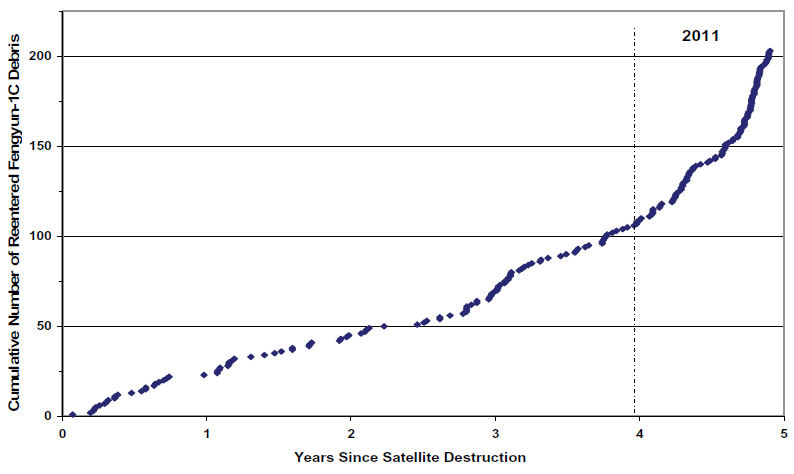
INCREASING SOLAR ACTIVITY CLEANS UP SAT-DEBRIS:

Earth's atmosphere has been puffing up in response to increasing levels of UV radiation from sunspots. This is good news for satellite operators, because a puffed up atmosphere helps clean up low-Earth orbit. "The number of cataloged debris in Earth orbit actually decreased during 2011," reports Nick Johnson in NASA's Orbital Debris Quarterly newsletter. "[The figure below] illustrates how the rate of debris reentries from the Fengyun-1C anti-satellite test of January 2007 increased during the past year."


Read more at http://spaceweather.com/

January 4, 2012

KN-Sat1 Ground Station is ready to go

The Cubesat team at University of Khartoum has finished installing the ground station equipments . It is ready now to tracking and monitoring many cubesats.

KN-Sat1 team members are willing to share knowledge and experience with any institute or university involving in cubesat programm.

contact email is
cubesat.uofk.edu@gmail.com


December 24, 2011

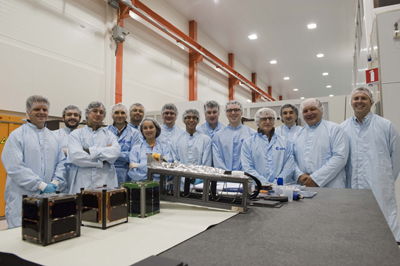
ESA’s CubeSats ready for flight


The first students' CubeSats to be sponsored by ESA’s Education Office have passed their Final Acceptance Review and have been declared ready for launch on board the maiden flight of Vega, the new ESA launcher. The launch window for this historic lift-off opens on 26 January and ends in the first week of February 2012.

The seven university-built picosatellites, each weighing only 1 kilogram, were integrated with the devices that will carry them during launch – the P-PODs, or Poly-Picosatellite Orbital Deployers – between late October and mid November. Before they could be cleared for launch, they had to pass a detailed technical examination known as the Final Acceptance Review.

READ MORE @ EAS- Education website


Sourse SGARC

December 9, 2011

TinySDR

TinySDR by LY1GP It's a very simple direct conversion receiver consisting of nothing more than three parts:

1) Simple LC band pass filter;
2) Mixer; and
3) VFO.

No AF amplifier stage, it just feeds the output direct to the sound card MIC input and leaves it to do the amplification etc. Oh, and the VFO is coupled into the mixer via a phase transformer thereby providing two different phases - one at 0 degrees and one at 90 degrees - and thereby making the output that of (I believe) an IQ SDR receiver.
My 1st version work very nice ,It need more work at VFO.
tnx VK1IS for the webblog .


See a Clip at youtube

CubeSats

Up to nine CubeSats built by European Universities will be flown during the debut of Europe's new Vega launch vehicle at the beginning of 2012. Together they represent a diverse range of designs and a variety of miniaturised technologies and sensors.

Up to nine CubeSats will be accommodated in three P-POD deployment systems which are to be mounted on the LARES primary payload. Each 1 kg CubeSat will be deployed into a high inclination, low Earth orbit, and is expected to operate in orbit for up to four years using a small ground station based at its respective university.
Read More